.jpg)
Ph.D. in Statistics, University of Oxford, United Kingdom (2008)
The focus of our research is on the development of both experimental and computational methods to interpret genomic and epigenomic data from plants, animals, fungi and human. By integrating data produce from the next-generation sequencing technologies, we would like to implement novel analytical strategies to solve problems in genetics and molecular biology.
Next generation genetics:
Next-generation or massively parallel DNA sequencing technologies have the potential to markedly accelerate genetics research. In our lab we perform DNA-seq for whole genome assembly, mRNA-seq for transcriptome studies, and BS-seq for DNA methylation profiling (WGBS and RRBS). Our goal is to integrate both experiments and statistical methods and software to address biologically relevant questions.
DNA methylation in plants:
Cytosine DNA methylation is an epigenetic modification of DNA that is usually associated with the stable and heritable repression of transcription. We would like to study DNA methylation in plants as their small genome sizes allow them to be sequenced economically. Plants are also easy to sample and tend to be amenable to genetic manipulations; the annotations of model plants are also well developed. Plant methylomes can provide important information for clarifying the mechanisms of action and characteristics of DNA methyltransferase enzymes, as well as contributing to a better understanding of the evolution of gene promoters and other regulatory sequences. Currently, we are investigating the genome wide DNA methylation pattern in maize meiocytes, rice transformation, and the stress responses in plants.
DNA methylation landscape in plants, animals, and human:
The genomes of many animals, plants and fungi are tagged by methylation of DNA cytosine. To understand the biological significance of this epigenetic mark it is essential to know where in the genome it is located. Our lab has several collaboration projects with UCLA to study the DNA methylation patterns in mammalian germ cells. For example, we are investigating the genome wide DNA methylation pattern on human prenatal germ cells. In addition, we are examining the impact of IVF (in vitro fertilization) on human and mice by studying the methylation status in fetus. New techniques are making it easier to map DNA methylation patterns on a large scale and the results have already provided surprises. We aimed to develop tools to understand the impact of this highly dynamic DNA methylation pattern and its function.
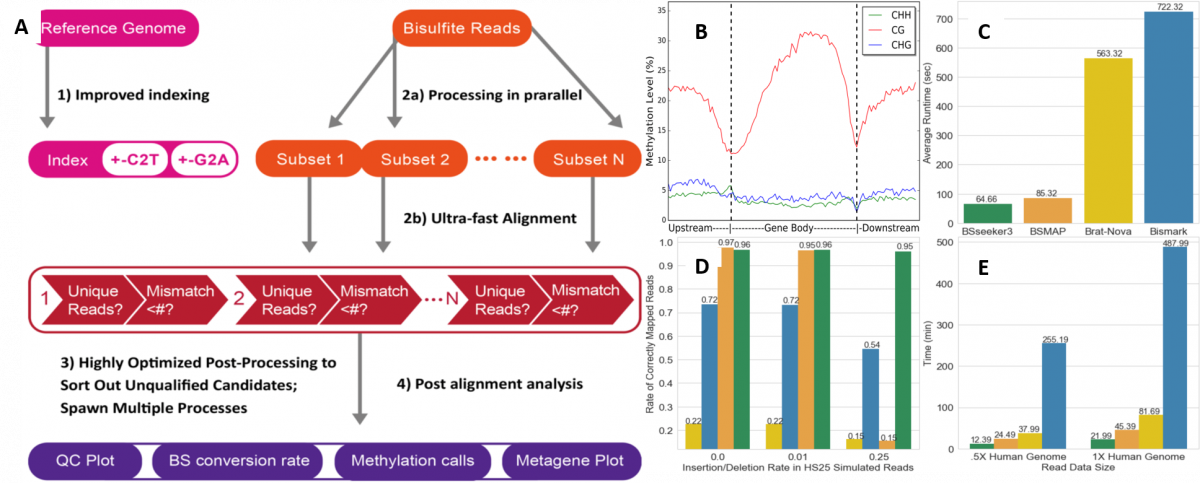
Summary of BS-Seeker3 pipeline and performance.
- (A)Schematic flow chart of BS Seeker 3 with improved indexing, data processing, fast alignment and post-alignment analyses
- (B)Metaplot of Methylation level: This metaplot presents the average methylation level distribution within a user-specified genomic structure (e.g., coding genes) inArabiodopsis thalania. CG denotes a CpG dinucleotide, CHG denotes a cytosine next to a H where H stands for A, C, or T.and then a guanine, CHH denotes a cytosine next to two H bases
- (C)Average user runtime of the four aligners on 10M simulated HiSeq 2500 Arabidopsis reads.
- (D)Percentage of the 10M simulated HiSeq2500 reads that were mapped correctly across various reads complexity level.
- (E)Average runtime of four aligners on directional BS-seq reads from real human data.
Domestic
- 2021: Professor Chu-Yung Lin Plant Biology Innovative Research Award, CY Lin Foundation for Plant Science and Education
- 2013: Recruiting International Outstanding Junior Scholar Award, Foundation for the Advancement of Outstanding Scholarship (FAOS)