.jpg)
Woei-Jiun GuoProfessor
E - Mail
Office Phone
+886-6-2757575#58212
Laboratory Phone
+886-6-2757575#58214#712
Highest Education
Purdue University Plant Biology Program USA Ph.D 2000.08 ~ 2005.06
National Taiwan University Department of Horticulture and Landscape Architecture TW M.S. 1997.07 ~ 1999.07
National Taiwan University Department of Physics TW B.S. 1993.09 ~ 1997.06
National Taiwan University Department of Horticulture and Landscape Architecture TW M.S. 1997.07 ~ 1999.07
National Taiwan University Department of Physics TW B.S. 1993.09 ~ 1997.06
Personal Website
Brief Biography
Department of Biotechnology and Bioindustry Sciences, NCKU Chairman 2023.08~now
Department of Biotechnology and Bioindustry Sciences, NCKU Professor 2022.08~now
Department of Biotechnology and Bioindustry Sciences, NCKU Associate Professor 2017.02~2022.08
Institute of Tropical Plant Sciences, NCKU, TW Adjunct Professor 2017.01~now
Institute of Tropical Plant Sciences, NCKU, TW Associate Professor 2016.02~2017.01
Department of Life Sciences, NCKU Adjunct Professor 2013.09~now
Institute of Tropical Plant Sciences, NCKU, TW Assistant Professor 2011.02~2016.01
Department of Plant Biology, Carnegie Institution for Science, Stanford, USA Postdoctoral 2008.10~2011.01
Institute of Plant and Microbial Biology, Academia Sinica, TW Postdoctoral 2005.09~2008.09
Department of Biotechnology and Bioindustry Sciences, NCKU Professor 2022.08~now
Department of Biotechnology and Bioindustry Sciences, NCKU Associate Professor 2017.02~2022.08
Institute of Tropical Plant Sciences, NCKU, TW Adjunct Professor 2017.01~now
Institute of Tropical Plant Sciences, NCKU, TW Associate Professor 2016.02~2017.01
Department of Life Sciences, NCKU Adjunct Professor 2013.09~now
Institute of Tropical Plant Sciences, NCKU, TW Assistant Professor 2011.02~2016.01
Department of Plant Biology, Carnegie Institution for Science, Stanford, USA Postdoctoral 2008.10~2011.01
Institute of Plant and Microbial Biology, Academia Sinica, TW Postdoctoral 2005.09~2008.09
Research Areas
Sugar is the key bioenergy for plant growth, as well as the important signal molecule. How to promote efficient sugar allocation to harvested organs is the key issue for crop yield. Thus, membrane-localized sugar transporters play a key role to regulate sugar distribution. Studies have shown that the SWEET sugar transporter is the core mechanism in the sugar export of organs, the sink-source carbon allocation, etc. Therefore, the long-term goal of this laboratory is to analyze and verify the importance and regulation of the SWEET mechanism in tomato, especially for fruit development and quality. Various molecular biology methods and gene editing strategies will be utilized. In addition, climate change in recent years, such as high temperature, flooding and other environmental stresses, has severely impacted food production and accelerated the occurrence of diseases and insects. Several studies also found that plant sugar allocation is related to its stress resistance. Therefore, the function and regulation of the SWEET mechanism upon the environmental stress will be further explored, with a view to applying molecular breeding to cultivate resilient varieties.
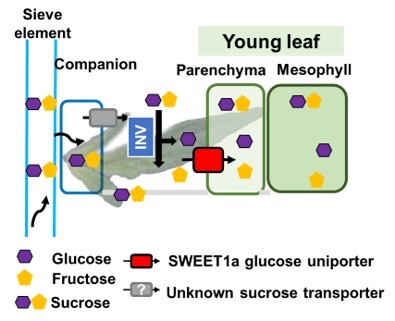 Vigorous vegetative growth is the foundation for high-yield reproductive growth. If more sugars can be provided during leaf development, a better leaf growth could contribute to subsequent fruit development. Using gene expression analysis, we discover that SlSWEET1a is highly expressed in young tomato leaves. Using the VIGS strategy and molecular biological analysis methods, we show that SlSWEET1a functions on the cell membranes of phloem parenchyma cells in young leaves. Its expression is increased with sugar unloading activity. When sucrose is released from the phloem into the apoplasm, it will be hydrolyzed into glucose and fructose. At this time, SlSWEET1a assists the rapid import of glucose into parenchyma cells to maintain the sucrose concentration gradient, so as to promote the continuous sugar unloading to support the growth of young leaves (Ho et al. 2019).
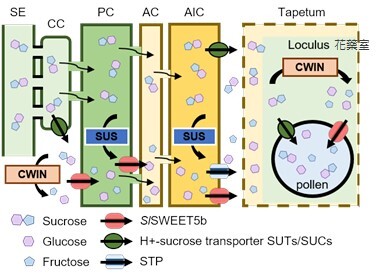 The development of reproductive organs, such as flowers, is the determinant of tomato fruit yield. We therefore explored the sugar transport mechanism that unloads sugars to flowers. Our results showed that SlSWEET5b is greatly expressed in mature flowers, especially in the cell membrane of mature pollen and anther phloem. Using the RNAi strategy in transgenic tomato plants, we reveal the key role of SlSWEET5b in pollen maturation. When sucrose is released from SE-CC cells and hydrolyzed into glucose and fructose in anther apoplasm, SlSWEET5b is located on the plasma membrane of parenchyma to promote rapid import of monosaccharides into anther cells. More importantly, when these monosaccharides are distributed into loculus, the membrane-localized SlSWEET5b transporter is the core import mechanism to import monosaccharides that are required for pollen maturation. A functional mutation in SlSWEET5b will induce male sterility and inhibit fruit production in tomato (Ko et al. 2022).
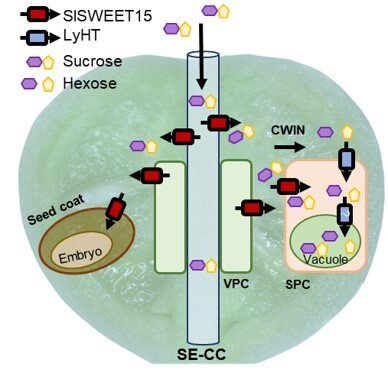 Fruit development is the final determinant of tomato yield and quality. Especially, sweetness of a fruit is directly related to sugar accumulation. We found that SlSWEET15 is distinctly expressed in the early stage of fruit development, in particular in vascular tissues of the pericarp and the seed coat. By characterizing CRISPR/Cas9 mutants, we confirmed that SlSWEET15 is the key mechanism for sugar unloading in tomato fruits. When sucrose is allocated to fruit phloem, SlSWEET15 is located on the plasma membrane of phloem SE-CC and neighboring SPC cells to mediate continuous sucrose export and import to support fruit growth. In addition, SlSWEET15 is also located on the membrane of seed coat to facilitate the import of sucrose into the developing seed for its carbon source. Therefore, its absence results in smaller fruits and severe seed abortion. This is the first time to reveal the sugar unloading mechanism in fruit (Ko et al., 2021). In the future, we will further investigate the possibility to enhance SlSWEET15 expression to promote fruit development in commercial cultivars.
Vigorous vegetative growth is the foundation for high-yield reproductive growth. If more sugars can be provided during leaf development, a better leaf growth could contribute to subsequent fruit development. Using gene expression analysis, we discover that SlSWEET1a is highly expressed in young tomato leaves. Using the VIGS strategy and molecular biological analysis methods, we show that SlSWEET1a functions on the cell membranes of phloem parenchyma cells in young leaves. Its expression is increased with sugar unloading activity. When sucrose is released from the phloem into the apoplasm, it will be hydrolyzed into glucose and fructose. At this time, SlSWEET1a assists the rapid import of glucose into parenchyma cells to maintain the sucrose concentration gradient, so as to promote the continuous sugar unloading to support the growth of young leaves (Ho et al. 2019).The development of reproductive organs, such as flowers, is the determinant of tomato fruit yield. We therefore explored the sugar transport mechanism that unloads sugars to flowers. Our results showed that SlSWEET5b is greatly expressed in mature flowers, especially in the cell membrane of mature pollen and anther phloem. Using the RNAi strategy in transgenic tomato plants, we reveal the key role of SlSWEET5b in pollen maturation. When sucrose is released from SE-CC cells and hydrolyzed into glucose and fructose in anther apoplasm, SlSWEET5b is located on the plasma membrane of parenchyma to promote rapid import of monosaccharides into anther cells. More importantly, when these monosaccharides are distributed into loculus, the membrane-localized SlSWEET5b transporter is the core import mechanism to import monosaccharides that are required for pollen maturation. A functional mutation in SlSWEET5b will induce male sterility and inhibit fruit production in tomato (Ko et al. 2022).Fruit development is the final determinant of tomato yield and quality. Especially, sweetness of a fruit is directly related to sugar accumulation. We found that SlSWEET15 is distinctly expressed in the early stage of fruit development, in particular in vascular tissues of the pericarp and the seed coat. By characterizing CRISPR/Cas9 mutants, we confirmed that SlSWEET15 is the key mechanism for sugar unloading in tomato fruits. When sucrose is allocated to fruit phloem, SlSWEET15 is located on the plasma membrane of phloem SE-CC and neighboring SPC cells to mediate continuous sucrose export and import to support fruit growth. In addition, SlSWEET15 is also located on the membrane of seed coat to facilitate the import of sucrose into the developing seed for its carbon source. Therefore, its absence results in smaller fruits and severe seed abortion. This is the first time to reveal the sugar unloading mechanism in fruit (Ko et al., 2021). In the future, we will further investigate the possibility to enhance SlSWEET15 expression to promote fruit development in commercial cultivars.
Awards
Teaching Excellence Award in Teaching Innovation-Online Teaching Group, NCKU 2025
Teaching Excellence Award in EMI Teaching Group, NCKU 2023
The 3rd CH-Biotech Innovation Award- Basic Theory Group First Prize Guidance Award 2022
Excellent Young Scholars Grant, NSC 2022
Professor CY Lin Memorial Award for Innovative Research Program 2021
Excellence in Teaching Awards, NCKU 2021
Outstanding Teacher in General Education, NCKU 2019
Ta-You Wu Memorial Award program, MOST 2019
Ta-You Wu Memorial Award, MOST 2017
Excellent young researcher Grant, MOST 2016
Outstanding Young Scholar Award, Taiwan Society of Plant Biologists, Taiwan 2015
Advise Hsin-Yi Chen to obtain 2014 The Best Plant Science Master Thesis Award, Taiwan Society of Plant Biologists, Taiwan 2014
Advise Hsin-Yi Chen to obtain 2013 Outstanding Poster Award and Poster Popularity Award, Taiwan Society of Plant Biologists, Taiwan 2013
NCKU travel grants, Taiwan 2013
Teaching Excellence Award in EMI Teaching Group, NCKU 2023
The 3rd CH-Biotech Innovation Award- Basic Theory Group First Prize Guidance Award 2022
Excellent Young Scholars Grant, NSC 2022
Professor CY Lin Memorial Award for Innovative Research Program 2021
Excellence in Teaching Awards, NCKU 2021
Outstanding Teacher in General Education, NCKU 2019
Ta-You Wu Memorial Award program, MOST 2019
Ta-You Wu Memorial Award, MOST 2017
Excellent young researcher Grant, MOST 2016
Outstanding Young Scholar Award, Taiwan Society of Plant Biologists, Taiwan 2015
Advise Hsin-Yi Chen to obtain 2014 The Best Plant Science Master Thesis Award, Taiwan Society of Plant Biologists, Taiwan 2014
Advise Hsin-Yi Chen to obtain 2013 Outstanding Poster Award and Poster Popularity Award, Taiwan Society of Plant Biologists, Taiwan 2013
NCKU travel grants, Taiwan 2013
Publications
● 期刊論文
● 研討會論文
● 專書
● 專利
● 技術報告/研究報告
Others