.jpg)
2015–2018 Postdoctoral Researcher, Department of Life Sciences, National Taiwan Normal University
Research Fields: Mating strategies, speciation, sexual selection, population genetics, molecular phylogenetics.
Current Research Topics:
How do differences and divergence among species arise, and how is phenotypic and behavioral polymorphism maintained within populations? Understanding how variation at different levels is generated, maintained, and what consequences it leads to is a fascinating question. To understand the origins and maintenance of interspecific and intraspecific polymorphism, it is necessary to start from behavioral ecology and integrate theoretical and empirical approaches from genetics and genomics in order to gain a deeper understanding of the evolutionary causes and consequences of behavioral and morphological variation.
To investigate interspecific and intraspecific variation and divergence, the laboratory currently focuses on two main research themes: speciation and mating strategies.
Speciation
From divergence among populations within a species to the establishment of complete reproductive isolation, speciation is often a long and complex process. In many cases, environmental pressures from biotic and abiotic sources drive adaptive divergence through natural selection, while sexual selection often facilitates the formation of reproductive isolation. However, this process can be weakened by gene flow between populations. Under the interaction among these three forces (see figure below), populations in divergence may follow different evolutionary trajectories, and whether environmental change disrupts this dynamic balance is a key question of interest. Currently, the laboratory uses two subspecies of damselflies as the model system to investigate the effects of natural selection, sexual selection, and gene flow on divergence.
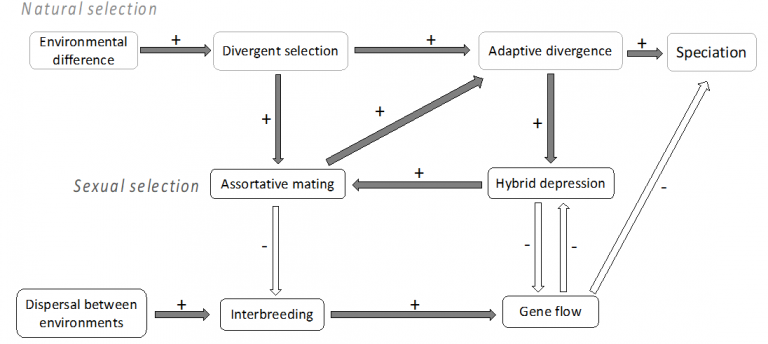 (Figure from Hsu, 2019)
Mating Systems and Mating Strategies
Animal mating systems can generally be classified into monogamy, polygyny, polyandry, and promiscuity. In wild animals, mating systems are not fixed by strict rules; even within the same species or population, multiple mating systems may coexist. My interest lies in understanding which biotic and abiotic factors shape these mating systems, how they evolve, and how they are maintained in nature.
Among different mating systems, socially monogamous passerine birds are of particular interest. Although socially monogamous, most passerine species exhibit extra-pair mating behavior. For males, extra-pair mating can increase reproductive success and typically does not require parental investment in extra-pair offspring, making it advantageous. For females, however, previous studies have shown that extra-pair mating may lead to reduced paternal care from their social partners, thereby decreasing offspring survival. Because of these costs, it has been widely suggested that females may gain indirect genetic benefits from extra-pair mating, such as producing offspring with higher survival or reproductive success by mating with males of superior quality (e.g., larger body size, more pronounced secondary sexual traits, or higher genetic compatibility). However, recent meta-analyses do not support this hypothesis and instead suggest no consistent difference between extra-pair males and social mates (see figure below). Our current research aims to investigate what other potential factors may explain why females maintain extra-pair mating behavior despite its costs.
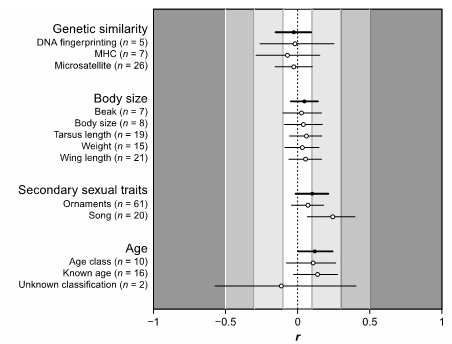 (Figure from Hsu et al., 2015, Molecular Ecology)