.jpg)
Lu-Shiun HerProfessor
E - Mail
Office Phone
+886-6-275-7575 ext.58125
Laboratory Phone
58104 or 58114轉59
Highest Education
Ph.D. in Biomolecular Chemistry, University of Wisconsin–Madison
Bachelor’s Degree in Medical Technology, National Taiwan University
Bachelor’s Degree in Medical Technology, National Taiwan University
Brief Biography
2009 Assistant Professor, National Cheng Kung University
Research Areas
Research Directions:
1. Axonal Transport
Communication between neurons occurs through transmission between axons and dendrites. Axonal transport within neurons primarily relies on microtubules as the main pathway, with motor proteins transporting materials to their required destinations. Axonal transport plays an extremely critical role; severe transport dysfunction or blockage can lead to neurological diseases and even neuronal death.
2. Autophagy and Microtubule-Mediated Transport
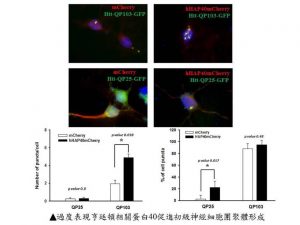
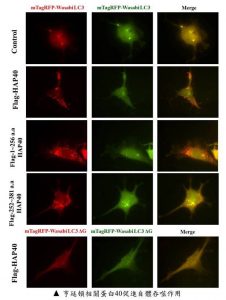
The main function of autophagy is to eliminate excessive, damaged, misfolded, or mutant proteins as well as aged organelles. Dysregulation of this process is associated with many diseases, such as cancer and neurodegenerative disorders. Common pathological features of neurodegenerative diseases such as Alzheimer’s disease, Parkinson’s disease, and Huntington’s disease include the accumulation of large amounts of protein aggregates in the brain. The degradation of these aggregated proteins mainly occurs through the autophagy pathway. The formation and accumulation of aggregate proteins in neuronal cell bodies are related to dysfunction in microtubule-mediated axonal transport. Studies have shown that microtubules are involved in autophagosome formation and in the fusion process between autophagosomes and lysosomes. Therefore, proper autophagy requires normal microtubule-based axonal transport.
Accumulating evidence also indicates that mitophagy plays an important role in neurodegenerative diseases. Mitochondria generate reactive oxygen species during energy conversion, and under stress conditions, the removal of damaged mitochondria is essential for maintaining normal cellular function. Thus, dysregulation of mitophagy may lead to neurodegenerative diseases. Current research focuses on how autophagy and mitophagy require normal microtubule-based axonal transport to remove misfolded or mutant proteins and damaged mitochondria, thereby protecting neurons and slowing disease progression. Under stress, reduced autophagy and mitophagy function leads to inflammation and promotes cell death.
1. Axonal Transport
Communication between neurons occurs through transmission between axons and dendrites. Axonal transport within neurons primarily relies on microtubules as the main pathway, with motor proteins transporting materials to their required destinations. Axonal transport plays an extremely critical role; severe transport dysfunction or blockage can lead to neurological diseases and even neuronal death.
2. Autophagy and Microtubule-Mediated Transport
The main function of autophagy is to eliminate excessive, damaged, misfolded, or mutant proteins as well as aged organelles. Dysregulation of this process is associated with many diseases, such as cancer and neurodegenerative disorders. Common pathological features of neurodegenerative diseases such as Alzheimer’s disease, Parkinson’s disease, and Huntington’s disease include the accumulation of large amounts of protein aggregates in the brain. The degradation of these aggregated proteins mainly occurs through the autophagy pathway. The formation and accumulation of aggregate proteins in neuronal cell bodies are related to dysfunction in microtubule-mediated axonal transport. Studies have shown that microtubules are involved in autophagosome formation and in the fusion process between autophagosomes and lysosomes. Therefore, proper autophagy requires normal microtubule-based axonal transport.
Accumulating evidence also indicates that mitophagy plays an important role in neurodegenerative diseases. Mitochondria generate reactive oxygen species during energy conversion, and under stress conditions, the removal of damaged mitochondria is essential for maintaining normal cellular function. Thus, dysregulation of mitophagy may lead to neurodegenerative diseases. Current research focuses on how autophagy and mitophagy require normal microtubule-based axonal transport to remove misfolded or mutant proteins and damaged mitochondria, thereby protecting neurons and slowing disease progression. Under stress, reduced autophagy and mitophagy function leads to inflammation and promotes cell death.
Awards
Publications
Others