
Effects of Sex and Individual State on Proactive Behavior in Bent-Wing Bats Across Different Contexts
Sex and state-dependent effects on proactive behaviors of bent-wing bats across contexts
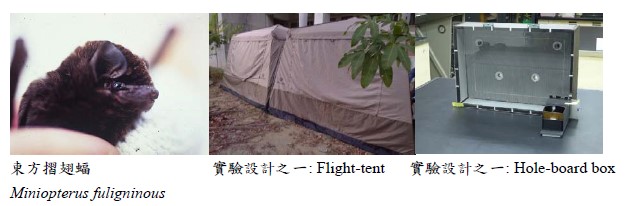
In animal populations, individuals often exhibit consistent behavioral differences across time and contexts, known as animal personality. Individual biological traits and the state formed through interactions between individuals and their environment may contribute to these behavioral differences or help maintain them. By measuring bat behavior across three experimental contexts, this study examines how individual state variables such as body mass, body condition, wing morphology, and parasite load influence personality traits in the East Asian bent-wing bat (Miniopterus fuliginosus). These test contexts include the hole-board box (HB), tunnel box (TB), and flight tent (FT), each simulating natural environments that bats may encounter and allowing them to express different modes of movement.
Through principal component analysis, three correlated personality traits—boldness, activity, and exploration—were integrated into a single principal component representing proactiveness. Based on Akaike Information Criterion (AIC), sex, body mass, body condition index (BCI), and wing morphology were selected as predictors of proactive behavior in the tunnel box (TB) and flight tent (FT) tests. In the hole-board box (HB) test, parasite load and abundance of bat flies were additionally included, while body condition index was not selected.
Our results showed that in both the hole-board box (HB) and flight tent (FT) tests, female bats exhibited a negative relationship between body mass and proactive behavior. In the HB test, male bats also showed a negative relationship between body mass and proactive behavior, whereas this pattern was not observed in the FT test. The negative association between body mass and proactive behavior, along with sex differences, is consistent with a mechanism involving state-dependent energy assimilation efficiency. On the other hand, our findings may also reflect feedback mechanisms related to individual state under specific environmental conditions. This latter interpretation provides an additional perspective that warrants further investigation into how personality traits vary along ecological gradients or seasonal changes.
Reference:
Yu-Jen Kuo, Ya-Fu Lee*, Yen-Min Kuo, Yik Ling Tai. 2024. Sex and state-dependent effects on proactive behaviors of bent-wing bats across contexts. Integrative Organismal Biology 6:1–13 https://doi.org/10.1093/iob/obad041