
Erinacine S, a bioactive extract from Hericium erinaceus, protects central nervous system glia–oligodendrocytes and improves cuprizone-induced myelin damage and mood-related behavioral abnormalities in rodents
Hericium erinaceus (lion’s mane mushroom) is a fungus that parasitizes and decomposes dead wood to obtain nutrients such as lignin and cellulose. In previous collaborative studies with Grape King Bio Ltd., we reported that mycelial extracts of H. erinaceus (HEM), and its bioactive small molecules erinacine A (HeA) and erinacine S (HeS), promote the differentiation and maturation of oligodendrocytes (OLs), the myelin-forming cells of the central nervous system, thereby supporting myelin development.
Building on these findings, we further investigated the protective potential of HEM, HeA, and HeS against oligodendrocyte and myelin damage in both acute and chronic cuprizone (CPZ)-induced demyelination rodent models. CPZ (cuprizone; a neurotoxic copper chelator) is widely used to induce demyelination in the central nervous system.
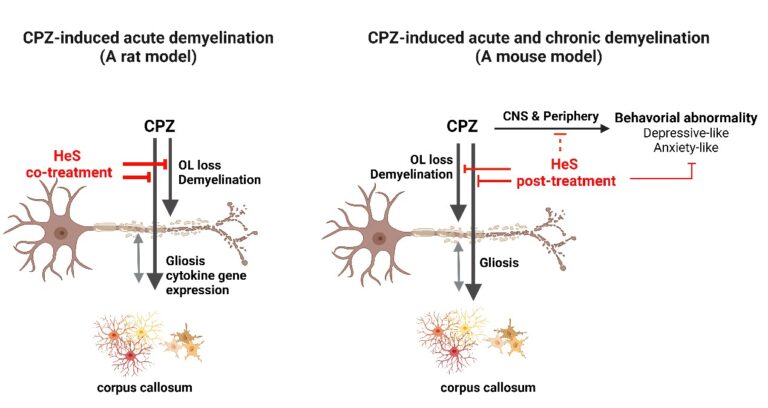
Our results showed that HEM and its component HeS effectively protect oligodendrocytes and myelin integrity. In acute demyelination models, both HEM and HeS counteracted CPZ-induced toxicity and exhibited anti-inflammatory effects in the corpus callosum. In oligodendrocyte culture experiments, HeS protected cellular morphology against damage induced by the pro-inflammatory cytokine IL-1β.
In vivo, delayed administration of HeS in an acute demyelination mouse model still significantly reduced myelin damage. However, in chronic demyelination models, delayed HeS treatment showed weaker protective effects, suggesting that early intervention is critical for optimal myelin protection.
Importantly, delayed HeS administration also improved CPZ-induced mood-related behavioral abnormalities in mice, indicating that erinacine S may have therapeutic potential not only for demyelinating conditions but also for associated neuropsychiatric symptoms.
Overall, these findings suggest that Hericium erinaceus mycelium and its active compound HeS may represent promising therapeutic candidates for alleviating demyelination and related emotional disorders.
Jing-Ting Fu (傅敬婷), Chih-Jou Yang (楊芷柔), Li-Ya Lee, Wan-Ping Chen, Yu-Wen Chen, Chin-Chu Chen, Yuan-Ting Sun, Chung-Shi Yang, Shun-Fen Tzeng*. Erinacine S, a small active component derived from Hericium erinaceus, protects oligodendrocytes and alleviates mood abnormalities in cuprizone-exposed rodents. Biomedicine & Pharmacotherapy, 2024, 173: 116297. https://pubmed.ncbi.nlm.nih.gov/38394854/