
APLF promotes DNA interstrand crosslink repair and replication fork protection, conferring cisplatin resistance
When DNA replication encounters exogenous or endogenous DNA damage, replication forks may stall, a condition known as replication stress. Replication stress can convert stalled replication forks into reversed replication forks, which is an important protective mechanism for maintaining fork stability and genome integrity. Paradoxically, this mechanism also operates in cancer cells, contributing to chemoresistance against various DNA-damaging agents.
Our previous study showed that PARP1 plays a critical role in the formation and maintenance of reversed replication forks and genome stability (PLoS Genetics 18: e1010545). PARP1 catalyzes the formation of poly(ADP-ribose) on itself and on target proteins. APLF, through its PBZ domain, binds poly(ADP-ribose) and is known to primarily participate in the non-homologous end joining (NHEJ) repair pathway.
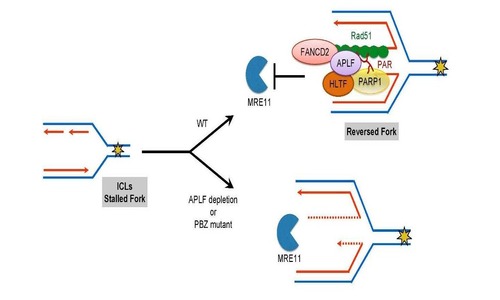
In this study, in collaboration with Dr. Wen-Bin Su from the Institute of Clinical Medicine, PhD student Cheng-Kuei Wu (co-supervised), Dr. Jia-Lin Shiu, and Dr. Yen-Chih Ho, we discovered a novel function of APLF in DNA interstrand crosslink repair and replication fork protection. We found that PARP1 promotes the recruitment of APLF to stalled replication forks, which in turn facilitates the recruitment of FANCD2 to these sites.
Reduction of APLF expression increases cellular sensitivity to cisplatin, impairs interstrand crosslink repair, and reduces FANCD2 recruitment to stalled replication forks. This ultimately leads to degradation of replication forks by the MRE11 nuclease. Furthermore, cisplatin-resistant cancer cells exhibit elevated expression of APLF and homologous recombination-related genes.
Knockdown of APLF sensitizes cells to cisplatin and results in replication fork degradation. Our findings reveal a novel role of APLF in promoting interstrand crosslink repair and replication fork protection, providing new insights into cancer drug resistance mechanisms and potential targets for future therapeutic development.
Cheng-Kuei Wu (吳政桂), Jia-Lin Shiu (許嘉麟), Chao-Liang Wu, Chi-Feng Hung, Yen-Chih Ho (何彥志), Yen-Tzu Chen, Sheng-Yung Tung, Cheng-Fa Yeh, Che-Hung Shen, Hungjiun Liaw*, Wen-Pin Su*. (2024, Mar). APLF facilitates interstrand DNA crosslink repair and replication fork protection to confer cisplatin resistance. Nucleic Acids Research. doi: 10.1093/nar/gkae211. Online ahead of print. https://pubmed.ncbi.nlm.nih.gov/38520407/