
Brood success in sex-role-reversed Pheasant-tailed Jacanas:
effects of social polyandry, seasonality, and male mating order
Brood success of sex-role-reversed Pheasant-tailed Jacanas:
the effects of polyandry, seasonality, and male mating order
Female multiple mating can enhance hatching rate and overall brood success; however, reproductive and parental investment may gradually deplete energy reserves and body condition, potentially reducing female output over time. Consequently, reproductive success in socially polyandrous systems may vary substantially among males.
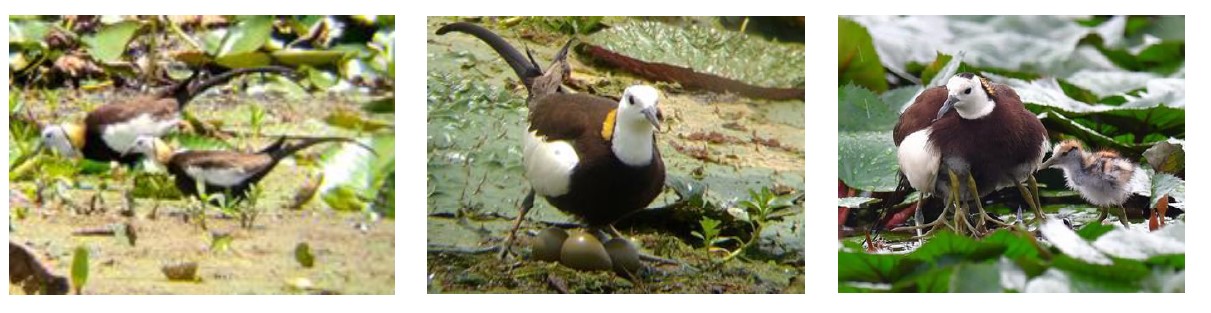
This study focused on the socially polyandrous and sex-role-reversed Pheasant-tailed Jacana (Hydrophasianus chirurgus) to examine the effects of social polyandry, seasonality, and male mating order on reproductive success.
Females mated with a single male (22%) or with two or more males (78%) to produce multiple clutches. Polyandrous females laid their first and second clutches earlier, resulting in a longer reproductive period—more than twice that of monandrous females. Both polyandry level and seasonality affected nest outcomes. Nests from polyandrous females and those produced in the first third of the breeding season showed higher hatching success and brood success, while the proportion of polyandrous females decreased over the season.
Polyandrous females produced more nests, eggs, hatchlings, and fledglings than monandrous females, and also showed higher per-nest output and hatching success. Within polyandrous systems, males achieved higher numbers of hatchlings and fledglings compared to males in monandrous or biandrous systems. They also showed higher per-nest hatchling and fledgling output as well as higher brood success.
However, first-ranked males in polyandrous systems only showed higher total numbers of nests, eggs, and hatchlings compared to later-mating males, with no significant differences in fledgling number, per-nest output, hatching rate, fledging rate, or overall brood success.
Overall, these results indicate a selective advantage in the polyandrous system of Pheasant-tailed Jacanas, particularly during the first third of the breeding season. This advantage varies among and within sexes and is influenced not only by individual quality but also by ecological and environmental factors.
Reference:
Ya-Fu Lee‡,*, Yen-Min Kuo‡, Bing-Yuan Chuang⸹, Hui-Ching Hsu⸹, Yi-Jun Huang⸹, Yu-Chen Su⸹, Wen-Chen Lee*. 2024. Brood success of sex-role-reversed Pheasant-tailed Jacanas: the effects of social polyandry, seasonality, and male mating order.
Zoological Letters 10:9 https://doi.org/10.1186/s40851-024-00231-2