
Lipid droplet accumulation and mitochondrial dysfunction induced in astrocytes exposed to a high-lipid mixture
In the central nervous system (CNS), astrocytes are major glial cells that play multiple roles, including providing metabolic support to neurons, supplying neurotrophic factors, facilitating neurotransmitter uptake, maintaining ionic homeostasis, and participating in synapse formation. In various neurological diseases (such as Alzheimer’s disease, Parkinson’s disease, and multiple sclerosis), lipid accumulation in brain tissue and lipid droplet formation in neurons and microglia have been observed. However, the response of astrocytes under a high-lipid microenvironment remains unclear.
In this study, we used primary astrocytes isolated from neonatal rat cortex and exposed them to a high-concentration lipid mixture containing cholesterol and various fatty acids to investigate astrocytic responses. The results showed that lipid mixture treatment induced lipid droplet accumulation in astrocytes, with droplet size increasing over time. Prolonged exposure to high lipid levels significantly reduced cell viability and decreased mitochondrial membrane potential (MMP), while increasing the expression of apoptosis-inducing factor (AIF).
In lipid-treated astrocytes, smaller lipid droplets were found to colocalize with microtubule-associated protein 1A/1B-light chain 3B (LC3) and lysosome-associated membrane protein 1 (LAMP-1), accompanied by increased lysosomal acidity. These findings indicate that a high-lipid microenvironment leads to persistent lipid droplet accumulation in astrocytes, together with mitochondrial and lysosomal dysfunction. Such disturbances impair lipid homeostasis in astrocytes, ultimately disrupting their cellular functions and survival and compromising their neuroprotective roles.
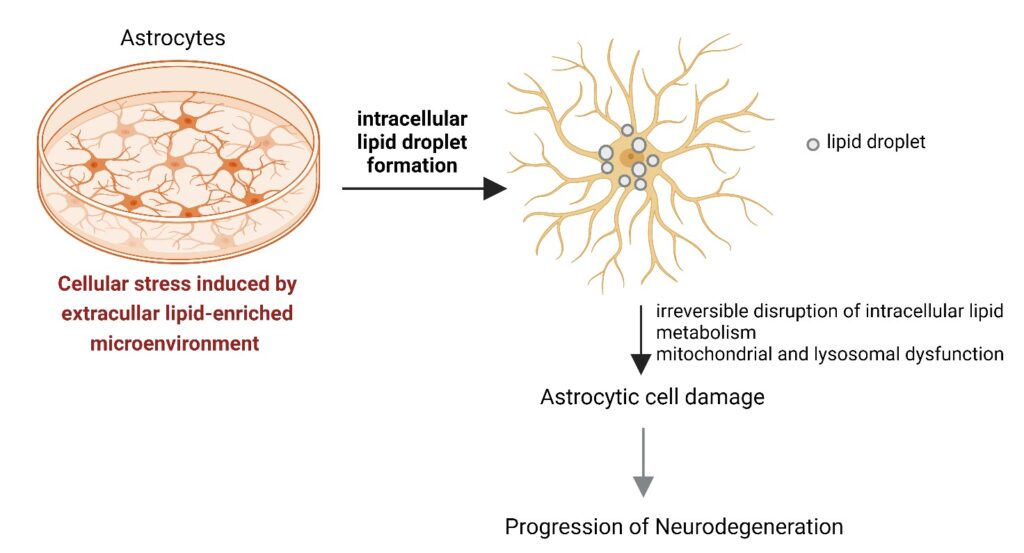
(The figure was created with BioRender.com)
Yi-Chen Li, Jing-Ting Fu, Shun-Fen Tzeng. Exposure to lipid mixture induces intracellular lipid droplet formation and impairs mitochondrial functions in astrocytes. Neurochemistry International 2024 Jun 14:105792. doi: 10.1016/j.neuint.2024.105792. Online ahead of print. (https://pubmed.ncbi.nlm.nih.gov/38880230/)