
Even when pollinator larvae are herbivorous, the pollinator crisis may still reduce plant abundance
Due to multiple environmental pressures, pollinating insects are experiencing a global decline (the so-called pollinator crisis), raising concerns about reduced plant productivity in both natural and agricultural ecosystems. However, only a few studies have addressed the simultaneous decline of both pollinators and plant abundance, and it remains unclear when a “plant crisis” actually occurs.
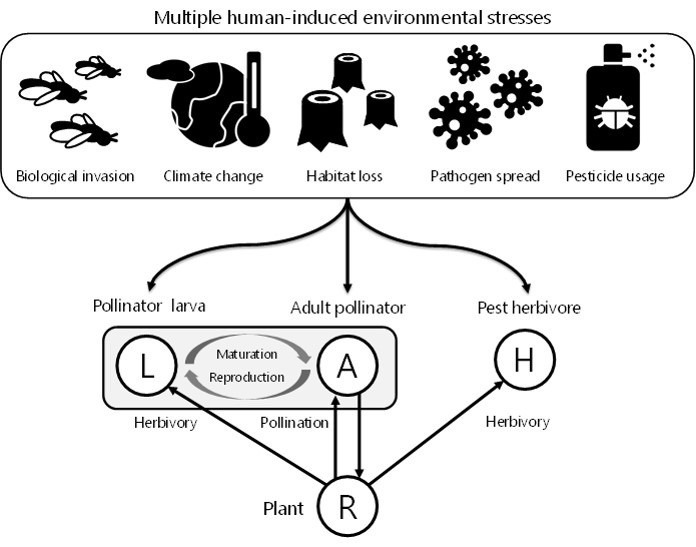
Here, we propose that anthropogenic environmental stressors acting on pollinating insects (e.g., climate change, habitat loss, and pesticide use) may also suppress herbivorous insects (such as pollinator larvae and agricultural pests). The resulting reduction in herbivores may offset the negative effects caused by pollinator loss. To test this idea, we theoretically investigated plant population dynamics driven by two types of insects: pollinators whose adults are mutualists but larvae are antagonists (herbivores), and herbivorous pests without complex life cycles.
Our model reveals that environmental stress (i.e., increased insect mortality) can have counterintuitive effects on plant populations. Nevertheless, plant abundance generally decreases as pollinator abundance declines, particularly when plant populations grow slowly in the absence of pollinators, when pollinators act as effective mutualists, or when pollinators are highly sensitive to environmental stress.
These findings provide a theoretical foundation for biodiversity conservation and agricultural management in understanding the broader consequences of the pollinator crisis.
Reference
Lee YD (Physics undergraduate student), Yokoi T (University of Tsukuba), Nakazawa T*. (2024) A pollinator crisis can decrease plant abundance despite pollinators being herbivores at the larval stage. Scientific Reports 14:18523. [Open Access] [Q1 in Multidisciplinary Sciences]