
Simulation-based prediction of diverse pigmentation patterns in harlequin Phalaenopsis orchids through perturbation of a spot-pattern formation equilibrium mechanism
The harlequin Phalaenopsis orchid (“harlequin flower”) originated as a somaclonal variant during tissue culture of Phalaenopsis species, and is known for its unprecedented mottled purple pigmentation patterns. Breeding experiences suggest that offspring traits of harlequin orchids are highly variable, and even progeny derived from tissue culture may show substantial differences in floral coloration compared to parental lines. Therefore, to improve the breeding stability of harlequin orchid coloration, we aimed to characterize the regulatory mechanisms underlying its highly variable pigmentation patterns.
Due to the high variability of floral patterns, obtaining reproducible experimental materials is challenging. In this study, we used computational simulations to investigate the interactions among the anthocyanin activator PeMYB11, the anthocyanin repressor PeMYBx, the retrotransposon Harlequin Orchids Retrotransposon 1 (HORT1), and microRNA858 (miR858), and constructed a conceptual regulatory model for spot-pattern formation in harlequin orchids.
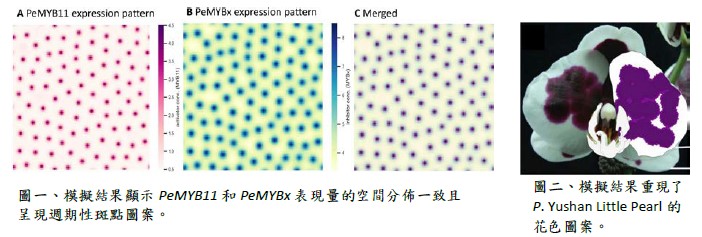
Our results show that although PeMYB11 and PeMYBx function antagonistically in anthocyanin biosynthesis, PeMYB11 promotes the expression of PeMYBx, thereby generating spotted pigmentation patterns (Fig. 1). It is known that full-length HORT1 suppresses PeMYB11 expression, whereas a single LTR of HORT1 enhances PeMYB11 expression. In addition, miR858 expression is lower in purple regions than in white regions, resulting in reduced degradation of PeMYB11 in purple areas, thereby enhancing anthocyanin accumulation under specific conditions.
Based on the constructed mathematical model of spot-pattern formation, simulations show that a single LTR of HORT1 enlarges pigment spots but is insufficient to cause spot fusion into continuous pigmentation, with a clear upper limit in spot expansion. In contrast, reduced degradation of PeMYB11 disrupts periodic spot formation. Thus, although both factors enhance anthocyanin accumulation, they influence pigmentation patterns in distinct ways. Simulation results further indicate that decreased miR858 expression expands the boundaries of large spots induced by HORT1, producing the characteristic mottled purple coloration of harlequin orchids.
We also found that the spatial distribution of full-length HORT1 and single LTR elements in petal tissues affects pattern formation. The model successfully reproduced the pigmentation pattern of Phalaenopsis ‘Yushan Little Pearl’ (Fig. 2). By revisiting previous experimental data and integrating mathematical modeling, we successfully clarified how multiple interacting factors regulate anthocyanin formation and accumulation in harlequin orchids. These findings provide a theoretical framework that may contribute to more stable and innovative breeding strategies in the future.
Publication:
Ti-Wen Lu, Wen-Huei Chen, Pao-Yang Chen, Yu-Chen Shu, and Hong-Hwa Chen. (2024) Perturbation of periodic spot-generation balance leads to diversified pigmentation patterning of harlequin Phalaenopsis orchids: in silico prediction. BMC Plant Biology, 24, 681.
https://bmcplantbiol.biomedcentral.com/articles/10.1186/s12870-024-05305-z