
When is lethal deceptive pollination maintained? A population dynamics approach
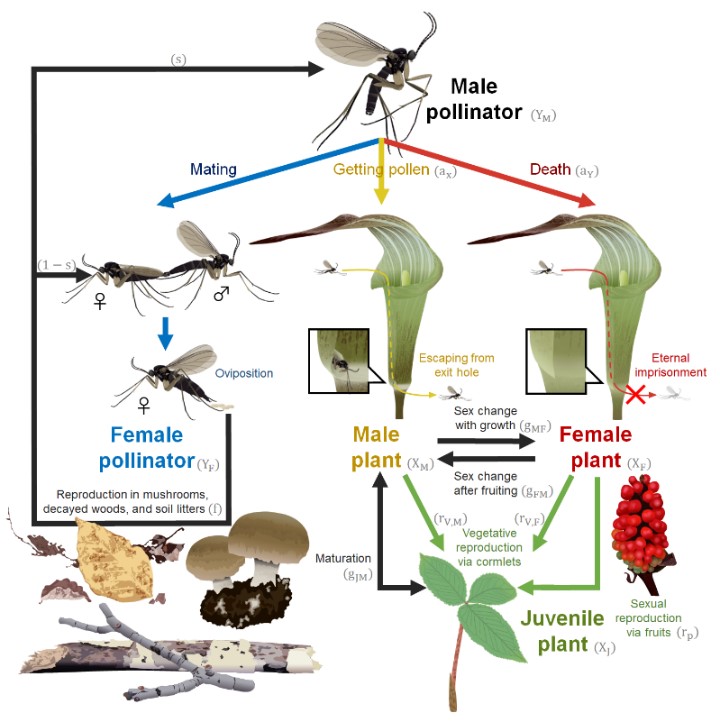
Not all plant–pollinator interactions are mutualistic; in fact, deceptive pollination systems are widespread in nature. Plants in the genus Arisaema exhibit a system known as lethal deceptive pollination, in which plants not only attract pollinating insects without providing any reward but also trap them until death. Many Arisaema species are currently threatened by various disturbances, including forest habitat loss, changes in understory vegetation caused by increasing deer populations, and plant poaching in horticultural trade. Our aim was to theoretically investigate, from a population dynamics perspective, how lethal deceptive pollination systems can be maintained, and how both plant and pollinator populations respond to different types of disturbances.
We developed and analyzed a mathematical model describing the population dynamics of deceptive plant species and their victimized pollinators. By calibrating the model using empirical data, we evaluated conditions for the coexistence of plants and pollinators while manipulating key parameters. Depending on changes in certain parameters, the model exhibited qualitatively different behaviors.
When vegetative propagation ability of the plant is low and the transition rate from male to female is slow, plant extinction occurs. In particular, when plants are highly attractive to male insects, coextinction of both plants and insects may occur. The increase in deer populations has both positive and negative effects due to the removal of competing plant species and reduced pollinator abundance. Plant poaching in horticultural settings can threaten populations regardless of whether male or female plants are frequently collected. Compared with other types of disturbances, the impact of forest habitat loss may be relatively limited.
Our results highlight that the demographic vulnerability of lethal deceptive pollination systems differs qualitatively from that of typical mutualistic pollination systems. Therefore, it is important to consider the population dynamics of both exploited pollinators and deceptive plants when estimating how endangered Arisaema species respond to various disturbances.
Reference
Nakazawa T*, Matsumoto TK (Ibaraki University), Katsuhara KR (Okayama University). When is lethal deceptive pollination maintained? A population dynamics approach. Annals of Botany, in press. [Open Access]
https://academic.oup.com/aob/advance-article/doi/10.1093/aob/mcae108/7725877?login=false