
Analysis of 2-phenoxychromone derivatives as novel inhibitors of lipid droplet formation in hepatocytes and adipocytes and their mechanisms of action
Abnormal accumulation of lipid droplets in hepatocytes increases the risk of metabolic dysfunction-associated steatotic liver disease (MASLD). In addition, excessive lipid droplet accumulation in adipocytes is closely associated with obesity, insulin resistance, and various metabolic complications, thereby contributing to the onset and progression of MASLD. Therefore, the development of drugs that can inhibit lipid droplet formation in both hepatocytes and adipocytes has important clinical implications.
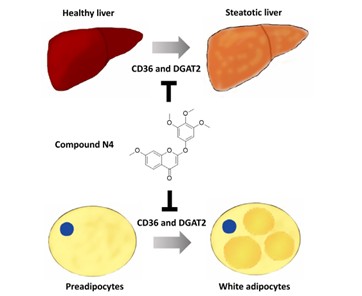
2-Phenoxychromones are a class of natural product–related compounds containing a chromone scaffold with phenoxy substitutions, widely found in various plants and known for antioxidant and anti-inflammatory activities. However, their roles in lipid droplet formation and lipid metabolism regulation remain unclear. In this study, we investigated the effects and mechanisms of a 2-phenoxychromone derivative, 7-methoxy-2-(3′,4′,5′-trimethoxyphenoxy)-chromen-4-one (compound N4), using HepG2 and 3T3-L1 cell models.
Results showed that compound N4 effectively inhibited oleic acid- and linoleic acid-induced lipid droplet formation in HepG2 cells, with IC50 values of 44.5 ± 7.1 μM and 52 ± 11.8 μM, respectively, without significant cytotoxicity (CC50 = 293.7 ± 12.9 μM).
At the molecular level, compound N4 suppressed oleic acid-induced lipid droplet formation in HepG2 cells by downregulating mRNA expression of ACC1, SREBP1, CD36, and DGAT2. For linoleic acid-induced lipid droplet formation, it reduced expression of CD36 and DGAT2.
In addition, compound N4 inhibited lipid droplet formation and adipocyte differentiation in 3T3-L1 cells, with an IC50 of 35.9 ± 6.5 μM, and decreased the mRNA expression of ACC1, SREBP1, CD36, DGAT2, C/EBPα/β, and PPARγ.
Collectively, these results indicate that compound N4 has potential as a novel inhibitor of lipid droplet formation and may serve as a promising therapeutic candidate for MASLD and obesity.
Yu-Tsen Hsieh, Tung-Hsuan Kang (co-first author), Hsin-Yi Hung, Yi-Han Chang, Kuan-Chen Cheng, Chia-Yih Wang, Wen-Tai Chiu, Pai-Sheng Chen, Shih-Chieh Lin, and I-Chen Peng*. (2025 Jul). Identification of a 2-phenoxychromone derivative as a novel inhibitor of lipid droplet formation in hepatocytes and adipocytes. Results in Chemistry 16:102389. https://doi.org/10.1016/j.rechem.2025.102389