
.png "Attachment-1,png(Opens in a New Window)") 17785827230271(1).png
17785827230271(1).pngFrom taboo to trend: surnames and modern mate choice
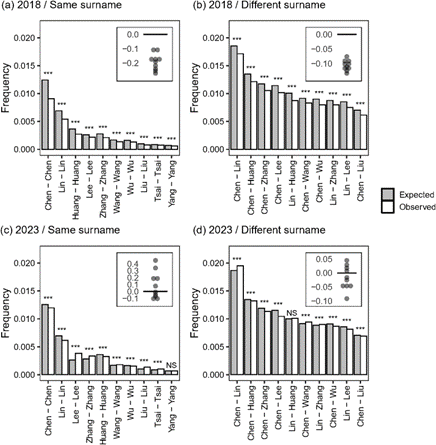
Kin recognition plays an important role in avoiding inbreeding across multiple biological groups, including bacteria, plants, and animals during mating processes. Historically, surnames in human societies have served as indicators of kinship, and many countries have enacted laws and social norms prohibiting marriage between individuals sharing the same surname. Against this background, and considering that surname mismatch may have adaptive value in avoiding inbreeding, we investigated whether surnames still influence mate choice in modern human societies where same-surname marriage is no longer prohibited. We analyzed Taiwan’s national name database. Data from 2018 showed that same-surname marriages occurred at a lower-than-expected frequency, reflecting historical taboos. However, this pattern was not observed in the 2023 data, suggesting that attitudes may have shifted over time. To further interpret this trend, we conducted a simple questionnaire survey among university students. The results showed that, contrary to traditional expectations, there was no significant correlation between shared surnames and attractiveness ratings of opposite-sex faces. Although preliminary, our findings suggest the hypothesis that the importance of surname matching/mismatching in mate choice may have declined, potentially due to rapidly changing sociocultural environments. Further investigation into the changing role of surnames may contribute to a more comprehensive understanding of human social behavior across regions and contexts in an era of modernization and globalization.
Reference
Nakazawa T* (Takeshi Nakazawa), Shinohara N (Naoto Shinohara, Kyoto University / OIST), Fukano Y (Yuya Fukano, Chiba University) (2026) Surname match/mismatch revisited: it may no longer matter for partner choice. PLoS ONE 21: e0343333.