
.jpg "Attachment-1,jpg(Opens in a New Window)") 17785827230259(1).jpg
17785827230259(1).jpgNeuroinflammation in the frontal–striatal circuit and corpus callosum induced by long-term high-fat diet consumption
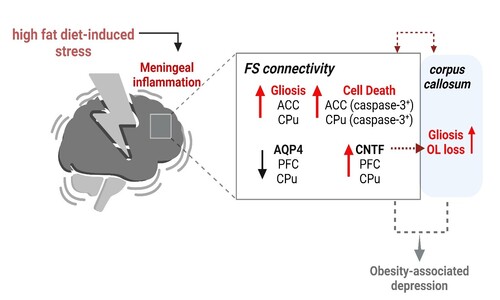
High-fat diet-induced obesity triggers both central and peripheral inflammatory responses, accompanied by astrocyte and microglial activation, leading to gliosis. Clinical evidence shows that obesity is associated with depression, and frontal–striatal connectivity (FS) is also linked to stress-related depression. This circuit includes brain regions such as the anterior cingulate cortex (ACC) in the prefrontal cortex (PFC) and the dorsal striatum, including the caudate–putamen (CPu). This study investigated whether chronic obesity induces neuroinflammatory responses in these brain regions. The results showed immune cell accumulation in the meningeal lymphatic system of obese mice, along with gliosis and glial activation in the corpus callosum, accompanied by a reduction in myelin and oligodendrocytes (OL). In addition, under chronic inflammatory conditions, aquaporin-4 (AQP4) expression was reduced in the prefrontal cortex and caudate–putamen, while expression of the cytokine gene CNTF was increased, potentially contributing to neural damage and disrupting normal brain glymphatic function.
(https://onlinelibrary.wiley.com/doi/10.1111/jnc.16236)
Jing-Ting Fu, Hui-Ting Huang, Pei-Chun Chen, Yu-Min Kuo, Po-See Chen, Shun-Fen Tzeng. Exploring the reduction in aquaporin-4 and increased expression of ciliary neurotrophic factor with the frontal–striatal gliosis induced by chronic high-fat dietary stress. Journal of Neurochemistry. 2024 Oct 7. doi: 10.1111/jnc.16236. Online ahead of print. (https://pubmed.ncbi.nlm.nih.gov/39374168/)