
.png "Attachment-1,png(Opens in a New Window)") 17785827230258(1).png
17785827230258(1).pngParasite manipulation of hosts may promote biodiversity
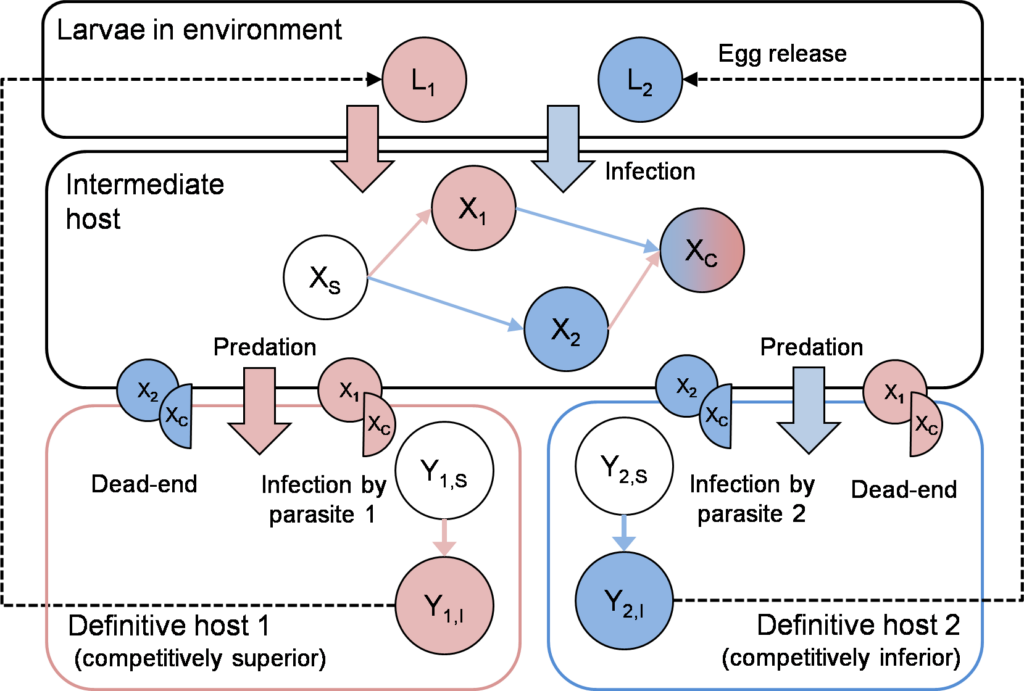
Parasites are highly diverse and play key roles in ecosystems, yet the mechanisms underlying this diversity remain poorly understood. Many parasites have complex life cycles and manipulate their hosts to facilitate transmission through trophic interactions between hosts. When multiple parasite species share the same intermediate host but ultimately target different definitive hosts, they face two major conflicts in host manipulation strategies.
First, host manipulation may increase predation by non-target predators, leading to “dead-ends.” Second, interactions among parasites can further complicate manipulation within co-infected intermediate hosts. To investigate how manipulating parasites compete and coexist under these conflicts, we developed a mathematical model describing the population dynamics of two parasite species, one intermediate host (prey), and two definitive hosts (predators).
The competitive exclusion principle predicts that, due to competition over the intermediate host, the two definitive hosts (and their associated parasites) cannot coexist. However, our results show that host-manipulating parasites can alter this outcome.
We identified three conditions that promote parasite coexistence: (i) parasites infecting the competitively inferior predator are more likely to fall into dead-ends due to broad host manipulation strategies; (ii) in co-infected intermediate hosts, manipulation decreases the predation rate of the dominant predator while increasing that of the inferior predator; (iii) host–parasite community dynamics exhibit only limited fluctuations.
We suggest that future studies should evaluate the likelihood of these conditions occurring in nature. In addition, we found that alternative stable states may arise across a wide parameter range, suggesting possible regime shifts in community composition.
These findings provide new insights into the mechanisms underlying parasite diversity and its stability, and lay a foundation for future studies under more complex ecological scenarios.
Reference
Wang CW (王之微, undergraduate student, Department of Economics), Chen HW (陳宣汶, National Chiayi University), Sato T (Takuya Sato, Kyoto University), Nakazawa T*. (2025) When can multiple parasites with complex life cycles coexist under conflicts of host manipulation? International Journal for Parasitology, in press.
https://www.sciencedirect.com/science/article/pii/S0020751925001584