
.jpg "Attachment-1,jpg(Opens in a New Window)") 17785827230257(1).jpg
17785827230257(1).jpgSexually different parental investment and its relationship with reproductive success in pheasant-tailed jacanas
Parental care and territoriality are key factors contributing to avian reproductive success. Biparental care, often dominated by females, is common in most bird species, while territorial defense during the breeding period is typically maintained by males or both parents. However, in socially polyandrous species, females may reverse typical sex roles, using parental care investment as a strategy to secure mating opportunities. On the other hand, these females may face physiological and environmental constraints due to repeated egg production and mating, which can lead to variation in egg mass and potentially influence offspring fitness.
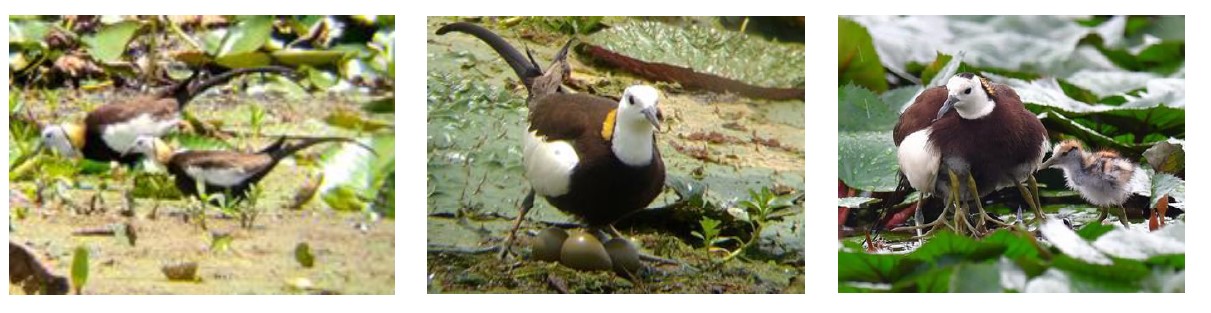
In this study, we examined the sex-role-reversed pheasant-tailed jacana (Hydrophasianus chirurgus) to evaluate sex differences in parental investment, including territorial behavior, time allocation to parental care, and egg production, and analyzed their relationships with reproductive success.
Results showed that female jacanas often monopolize small ponds but share larger water bodies with neighboring females, while tending to occupy larger territories in such environments. In contrast, male territories are entirely nested within those of their female partners, and male territory size is unaffected by the presence of neighboring males, but is positively correlated with the number of chicks that hatch and survive.
Parental care time allocation differed significantly between sexes and across breeding stages (pre-laying, incubation, and post-hatching). However, breeding duration, territory size, and the order of female reproduction or male mating did not affect parental care time allocation.
Furthermore, the amount of time parents spent caring for chicks was positively correlated with reproductive success, whereas time spent preening showed a negative correlation with chick survival. Other behavioral variables showed no significant effects on reproductive output.
Egg mass and shape variation in jacanas was limited, with no clear annual or within-clutch differences. The fourth egg in a clutch tended to be lighter. Across clutches, eggs laid later in the breeding period and by females with more mates tended to be heavier. Mean egg mass per clutch was positively correlated with the average number of hatched and surviving chicks.
Overall, our results suggest that female pheasant-tailed jacanas in a polyandrous system incur substantial pre-laying reproductive investment costs, while reproductive success is shaped by multiple factors, including male parental investment and environmental conditions.
Reference:
Yen-Min Kuo‡, Ya-Fu Lee‡*, Bing-Yuan Chuang⸹, Yu-Jen Kuo⸹, Hui-Ching Hsu⸹, Yen-Yin Chiang, Yik-Ling Tai, Siang-Lan Chang, Chia-Yu Lin, Yi-Jun Huang, Wen-Chen Lee. 2025.
Sexually different parental inputs in pheasant-tailed jacanas and the correlates with brood success. Integrative Organismal Biology 7.
https://doi.org/10.1093/iob/obaf035