Honors and Awards
Associate Professor Yi-Ching Chen of the Department of Life Sciences at National Cheng Kung University, together with a team from Academia Sinica and an international research team, estimated the “global mountain climate velocity” and published the f
Updated Date:2024-03-28 Number of Views:159

```html id="ncku_nature_climate_velocity"

Associate Professor Chen Yi-Ching and Academia Sinica Team, Together with an International Consortium, Estimate “Global Mountain Climate Velocity” — Published in Top Journal Nature, Identifying 17 High-Risk Regions Worldwide
Written by Chen Yi-Ching, Meng Qingci | Photos by Chen Yi-Ching, Weng Jin-Zhong
Scientists have long sought to understand how far uphill mountain species must move in elevation in response to ongoing global warming in order to remain within their suitable temperature ranges—an indicator known as “mountain climate velocity.” However, due to the complexity of mountainous terrain worldwide and the extremely low density of climate monitoring stations, this question has been difficult to answer in the past.
Associate Professor Chen Yi-Ching of National Cheng Kung University’s Department of Life Sciences, together with a team from Academia Sinica and an international consortium, has achieved a major breakthrough. By using satellite data and the “moist adiabatic lapse rate” derived from thermodynamic principles, the team has, for the first time, estimated global mountain climate velocity, revealing the pressures faced by mountain biodiversity.
This groundbreaking paper, Climate velocities and species tracking in global mountain regions, has been published in the leading international journal *Nature*.
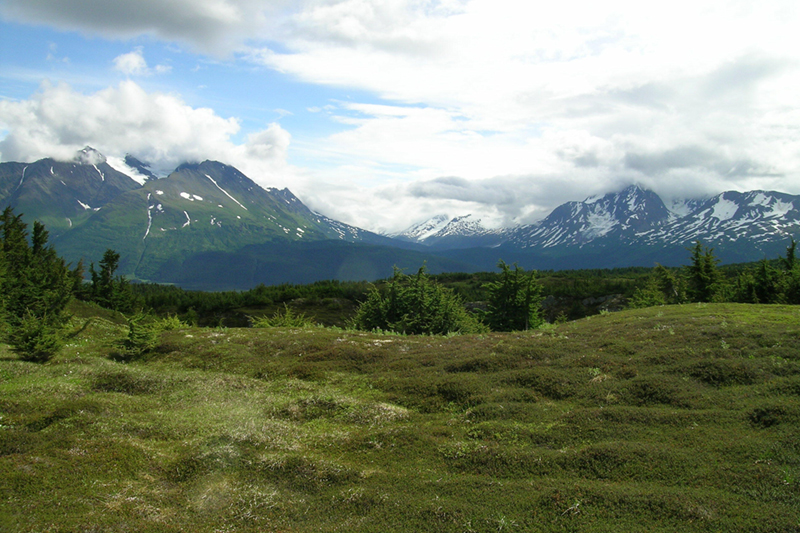
Both arid and humid mountain regions may experience high climate velocity pressure. Many regions have already experienced high climate velocity, such as the Alaska–Yukon mountains (photo by Jonathan Lenoir).
The study shows that over the past 50 years, 17 mountain regions worldwide have already experienced relatively high climate velocity. These high-risk areas are widely distributed, covering 32% of global mountain regions—from the Alaska–Yukon region to South Africa, and from Mediterranean mountains to Northeast Asia. They span both arid and humid climates and overlap with multiple biodiversity hotspots, indicating widespread threats to global mountain biodiversity.
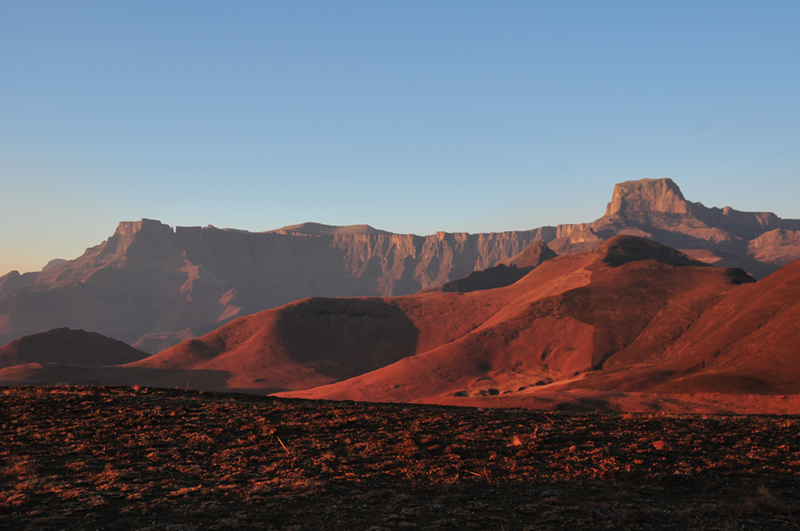
Several high-risk regions overlap with biodiversity hotspots, including the South African highlands (photo by Chen Yi-Ching).
In 2011, Associate Professor Chen Yi-Ching published a study in *Science* that first showed mountain species globally are significantly lagging behind climate velocity, attracting widespread attention and being cited in over 5,000 papers to date.
A decade later, a new international team analyzed more than 13,000 biological records alongside updated estimates of mountain climate velocity, offering both concern and hope. In regions with low climate velocity, species still have a chance to keep pace with climate change. However, in areas with high climate velocity, targeted conservation measures are urgently needed.
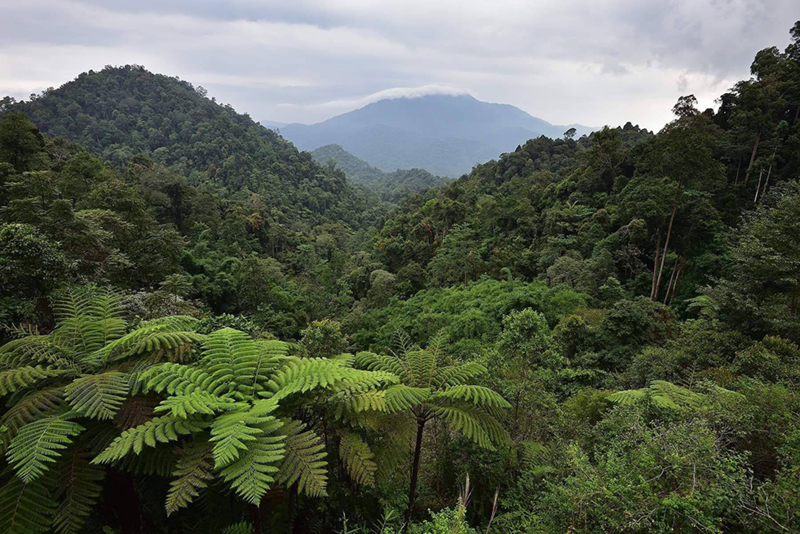
High-risk regions overlapping with biodiversity hotspots, including mountainous regions in Malaysia (photo by Wu Shih-Wei).
Mountain climate velocity varies greatly worldwide and is influenced not only by the magnitude of temperature rise but also by atmospheric moisture. The research team emphasizes that humid climates reduce the temperature lapse rate (the rate at which temperature decreases with elevation), resulting in faster climate velocity.
Regions such as Sumatra, Taiwan, Japan, and South Africa share these conditions. In such environments, organisms must migrate to higher elevations to remain within suitable temperatures. If species responses lag behind, their survival will be severely threatened.
Climate change biology is one of Associate Professor Chen Yi-Ching’s main research fields.
Mountain ecosystems are critical systems supporting human life, and the impacts of climate change on mountain biodiversity cannot be ignored. Associate Professor Chen Yi-Ching highlighted several key implications of this study:
First, accurately assessing local climate velocity still requires the establishment of mountain climate monitoring networks, not only measuring temperature but also humidity and precipitation.
Second, efforts to mitigate global warming remain essential, as reducing climate velocity helps species adapt.
Third, improving habitat connectivity and integrity allows organisms to adjust their distributions in response to climate change. In this regard, Taiwan’s promotion of a national ecological green network—linking lowlands to mountainous habitats—is particularly important.
The paper includes two corresponding authors: Associate Professor Chen Yi-Ching and Research Fellow Shen Sheng-Feng from Academia Sinica’s Biodiversity Research Center. The first author is Dr. Zhan Wei-Ping, a postdoctoral researcher at Harvard University’s Rowland Institute.
Additional contributors include Dr. Jonathan Lenoir (Université de Picardie Jules Verne, France), who compiled the species distribution database; Professor Kuo Hong-Chi from National Taiwan University’s Department of Atmospheric Sciences, who provided expertise in atmospheric dynamics; and Dr. Mai Kuan-Shuo from Academia Sinica’s Biodiversity Research Center, who participated in the analysis.
Source: NCKU News Center
```
More News